
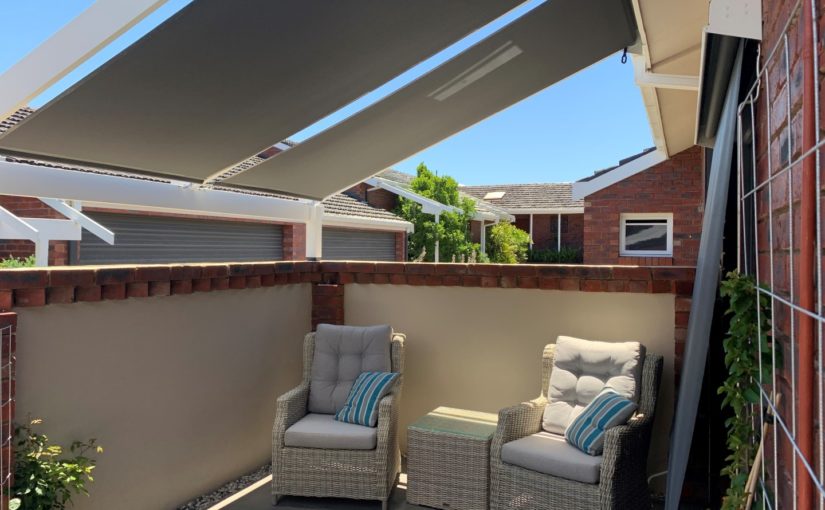
If your patio already has a glass or polycarbonate roof but still gets too much direct sunlight, adding a retractable shade underneath may be worth considering. Retractable roof systems and under-roof patio shades can provide adjustable shade without automatically requiring the existing roof to be removed. However, the right solution depends on the structure, available clearance, mounting points, and type of shade selected.
For Melbourne homeowners, this can be a practical option to investigate before committing to a larger patio renovation. The patio shade systems can be installed above or underneath existing glass or polycarbonate roofing, with pleated and pull-out options available. However, a site assessment is the best way to establish whether a particular system will suit your patio.
In this guide, we’ll explain how retractable roof systems can be installed beneath existing glass or polycarbonate patio roofs, the factors that affect suitability, and how to choose the right patio shade for your outdoor space.
Can You Add Retractable Shade Under a Glass or Polycarbonate Patio Roof?
In many cases, yes. An existing patio roof does not necessarily prevent you from adding a separate retractable shading layer underneath it. However, not every roof or shade system is compatible, so the mounting arrangement and available space need to be checked before choosing a product.
The purpose of the additional shade is different from that of the existing roof. The glass or polycarbonate covering remains in place, while the retractable shade can be extended when you want less direct sunlight and drawn back when you want more daylight.
This approach may appeal to people who like having a covered outdoor area but find that the space becomes too bright or uncomfortable at certain times of day. It can also allow you to explore an adjustable shading solution without assuming that the whole roof must be replaced.
Patio shades generally include pleated patio shades, pull-out patio shades, and retractable patio roof options. The suitable configuration will depend on the existing structure and the result you want to achieve.
How Do Under-Roof Patio Shades Work?
An under-roof patio shade is fitted beneath the existing roof, using an appropriate support and operating arrangement. Depending on the selected product, the shade may run along guide wires or tracks and fold, roll or retract out of the way when it is not needed.
The aim is to give you control over the amount of shade across the covered area. Rather than having a fixed opaque layer beneath the roof at all times, a retractable system can be opened or closed according to your preferences and the conditions.
Operating methods vary by product. Some pleated patio shades use a rope-and-pulley arrangement, while pull-out shades may use a spring or crank mechanism. Motorised options are also available in Melbourne; however, you must confirm the operation and compatibility of the specific patio shade before selecting it.
Retractable outdoor blinds and other outdoor shade products may also be worth comparing if the main issue is sunlight entering from the sides rather than through the roof. A vertical blind or sunshade serves a different purpose from a shade fitted horizontally beneath the roof, so identifying where the sunlight enters is an important first step.
Glass vs Polycarbonate: What Should You Check?
Both glass and polycarbonate can form part of a covered patio, but the material alone does not determine whether a shade can be installed beneath it. The design of the roof, the supporting frame, and the available mounting points are all important.
Existing glass patio roofs
For a glass roof, the installer needs to establish where the shade’s support components can be fixed safely. The glass itself should not be treated as a mounting point unless the system’s specifications explicitly allow it. The arrangement of the supporting beams, access to those supports, and room for the shade to move must be assessed.
It is also worth discussing how the shade will be reached for cleaning or maintenance. A system that fits physically may still be inconvenient if its operating components are difficult to access once installed.
Existing polycarbonate patio roofs
With polycarbonate roofing, the installer should examine the roof profile, support structure and clearance beneath the sheets. The fixing method needs to be appropriate for the supporting frame rather than assumed to be suitable simply because the roof is lightweight or translucent.
Check whether beams, rafters or other suitable supports are positioned where the proposed tracks or guide wires need to run. The installer should also consider how the shade will retract and whether any existing lighting, fans, drainage components, or other fittings interfere with its movement.
Questions to answer before choosing a system
- Where are the structural supports and suitable mounting points?
- Is there enough clearance for the shade, tracks, and operating components?
- Can the shade travel through its full range without obstruction?
- Can the system be accessed for cleaning, adjustment, and maintenance?
- Is the main goal to reduce direct sunlight, glare, or light entering at the sides?
These checks help narrow the options, but they do not replace an on-site assessment of the existing roof and proposed installation.
Which Patio Shade Configuration Could Suit Your Space?
The best choice depends on the shape of your patio, the support arrangement, and how you want to operate the shade. Two options worth discussing are pleated patio shades and pull-out patio shades.
Pleated patio shades
Pleated patio shades fold back as they retract and can run along guide wires or a track system, depending on the product. This style may be worth investigating where you want the shade to gather neatly when it is not in use. The available space, span and mounting arrangement still need to be checked for the particular installation.
Pull-out patio shades
Pull-out patio shades that extend horizontally and clip into position. Its spring and crank operation allows the shade to be extended when needed and retracted when it is no longer required.
This configuration may be useful where a pleated system is not suitable for the available space. So, ask the installer to confirm the operating clearance and the fixing points required for your patio before deciding.
When another shade solution may be better
An under-roof shade may not solve every outdoor comfort problem. If the sun enters mainly through open sides, vertical retractable outdoor blinds or patio window shades may be more relevant. A pergola Awning or folding arm retractable awning may suit a different layout, but these products should not be treated as interchangeable with a shade fitted under an existing roof.
Likewise, if you need substantial changes to the roof structure, want to replace the current covering, or have requirements beyond adjustable shade, discuss those needs before selecting a product. The aim is to identify a suitable solution, not to fit a particular system regardless of the site.
Installation Checks Before You Request a Quote
1. Confirm suitable mounting points
The shade needs a suitable support arrangement. The installer should identify where the tracks, guide wires, or other components can be fixed and whether the existing frame is appropriate for the proposed system. Do not assume that the roof sheets themselves can support the installation.
2. Measure the available clearance
Check the space between the existing roof and the area beneath it, including the clearance required for brackets, tracks, fabric, and operating components. Fans, lights, beams, and other fittings may affect the available space. Accurate measurements help determine which configurations are practical.
3. Check the full movement path
A retractable shade needs room to extend and retract. Ask whether beams, lights, downpipes or other fixtures could obstruct its movement, and whether the system can be operated conveniently from the intended position.
4. Choose an operation method
Manual, crank, rope-and-pulley and motorised mechanisms each have different requirements. An Electric Awning or motorised shade may be worth discussing if convenient operation is a priority, but the exact motorisation options must be confirmed for the selected system.
5. Be clear about the result you want
Tell the installer when the patio gets the most sun and whether the main concern is glare, brightness or general shade. If you also need protection from rain or wind, explain that separately. A retractable shade beneath an existing roof should not automatically be assumed to make the roof waterproof or provide the same performance as a purpose-built weatherproof roofing system.
6. Plan for access and maintenance
Ask how the fabric, tracks and operating components will be cleaned and maintained after installation. The existing roof may affect access, so this should be considered before the system is fitted.
However, remember that the permit requirements depend on the existing structure and the work proposed, so check the Victorian Building and Plumbing Commission’s guidance on landscaping and outdoor structures and contact your local council if you are unsure whether approval is required.
Quick Suitability Checklist: Is an Under-Roof Shade Worth Investigating?
An under-roof retractable shade may be worth assessing if the following statements describe your patio:
- You want adjustable shade: You would like to reduce direct sunlight at certain times while retaining the option to let more light through.
- The existing roof can remain: Your aim is to improve comfort beneath the current glass or polycarbonate covering, rather than replace it.
- Suitable supports may be available: The patio has a frame or other appropriate mounting points that an installer can assess.
- There is room for the mechanism: The proposed shade, tracks, and operating components may fit without interfering with existing fittings.
- You can access the system: The shade can be operated and maintained safely once installed.
- Your performance expectations are clear: You understand whether you need sun and glare control, side screening, or a separate weather-protection solution.
Important: This checklist helps you prepare for an assessment; it cannot confirm compatibility. The actual roof structure, dimensions, and product specifications need to be reviewed before a final recommendation is made.
Is an Under-Roof Shade Better Than Replacing the Roof?
It depends on what you want to change. If your existing roof is in suitable condition and the main issue is direct sunlight, an adjustable shade beneath it may be a useful option to investigate. It lets you explore a shading upgrade while retaining the existing covering, subject to compatibility.
If the roof itself needs repair, replacement, or structural changes, adding a shade may not address the underlying problem. Similarly, if your priority is weather protection rather than control over sunlight, you should explain that requirement so the installer can discuss appropriate alternatives.
Also, compare the likely scope of work, access requirements, operation and maintenance, not just the product name. Custom patio shades should be selected for the actual space and intended use. After all, a quote based on the existing structure and accurate measurements will be more useful than choosing a system from photographs alone.
Frequently Asked Questions
In many cases, it may be possible to fit a retractable shade beneath a polycarbonate patio roof. Suitability depends on the supporting structure, mounting points, clearance, and the chosen system. So, have the installation assessed before ordering.
Potentially, yes. The installer must identify appropriate fixing points and confirm there is enough room for the shade to move and operate. The glass itself should not be assumed to be a suitable fixing point.
A shade may help reduce direct sunlight and glare, but the result depends on the roof, shade material, colour, orientation and ventilation. Ask the supplier what performance is realistic for your particular patio rather than relying on a universal temperature-reduction claim.
Neither option is best for every patio. Pleated shades fold back along their guide arrangement, while pull-out shades extend and can clip into position. Available space, mounting points, span and operating preferences help determine which is suitable.
The existing roof may be retained if it is in suitable condition and the selected shade can be safely fitted beneath it. The installer should confirm the mounting method, access, and any work needed around the existing roof before proceeding.
Motorisation depends on the particular shade system and its available options, and you should confirm whether a motorised configuration is suitable for your proposed installation.
Requirements depend on the nature of the work, the existing structure and the property. So, do not assume that every installation is exempt. Make sure you check with your local council or a suitably qualified building professional if the work may affect the structure or require approval.
Arrange an Assessment for Your Existing Patio Roof
If your glass or polycarbonate patio roof lets in more sun than you would like, an under-roof shade may be worth exploring before you commit to a larger renovation. Start by reviewing Coolabah Shades‘ Patio Shades range and consider whether a pleated or pull-out configuration may suit your space.
The best part is they offer a free, no-obligation measure and quote. Simply share details about your existing roof, where the sunlight enters, and how you want to use the patio. An assessment can help establish which options are practical for your structure and requirements. So, visit the Contact Us page to enquire further.